.svg)

What Older Adults Need to Know About Age-Related Macular Degeneration
What Older Adults Need to Know About Age-Related Macular Degeneration

What Older Adults Need to Know About Age-Related Macular Degeneration
What Older Adults Need to Know About Age-Related Macular Degeneration
Published on
August 5, 2026
Funding for content provided by Bayer®
Funding for content provided by Bausch + Lomb

In this article:
Thank you! Your submission has been received!
Oops! Something went wrong while submitting the form.
Jump to a section:
Thank you! Your submission has been received!
Oops! Something went wrong while submitting the form.
As we age, changes in vision are common, but some changes deserve special attention. Age-related macular degeneration (AMD) is a progressive eye disease that damages the macula (the part of the retina responsible for sharp, central vision)1 and it’s one of the leading causes of irreversible vision loss in adults over 50.2 While AMD does not cause complete blindness, it can make everyday activities like reading, driving, recognizing faces, or seeing fine details more difficult.1
The good news is that early detection, healthy habits, and proper management can help protect vision and slow progression for many people.1
What Is Age-Related Macular Degeneration (AMD)? / The Two Types of AMD
AMD affects the macula, a small but critical area in the center of the retina at the back of the eye. The macula is responsible for sharp, central vision, like the kind you use for closeup and detailed tasks.1
A helpful way to think about the eye is like a camera:
- Light enters through the lens
- The retina acts like film or a digital sensor
- The macula sits at the center of the retina and provides clarity and color
When the macula is damaged, central vision becomes blurry, distorted, or faded, while side (peripheral) vision usually remains intact.3
AMD often develops gradually, and in its early stages may cause no noticeable symptoms, which is why regular eye exams are so important.1
The Two Types of AMD
There are two main forms of age-related macular degeneration:1,2,4
Dry AMD (Most Common)
- Accounts for the majority of AMD cases
- Occurs when the macula gradually thins with age
- Small deposits of proteins and lipids called drusen build up under the retina
- Vision changes tend to happen slowly over years
- Dry AMD has early, intermediate, and late stages
Wet AMD (Less Common but More Serious)
- Develops when abnormal blood vessels grow under the retina
- These vessels can leak fluid or blood, damaging the macula
- Vision loss is often faster and more noticeable
- Wet AMD always represents late-stage disease
Warning Sign: Monitoring Matters
In some people, dry AMD can progress to wet AMD, which is why monitoring matters.1
Symptoms depend on the type and stage of AMD.
Early Dry AMD:
- Often no symptoms at all
Intermediate AMD:
- Mild blurriness in central vision
- Difficulty seeing in low light
Late AMD (dry or wet):
- Straight lines appearing wavy or crooked
- A blurry, dark, or empty spot near the center of vision
- Colors appearing faded or less vibrant
- Increasing difficulty reading or recognizing faces
Warning Sign: Act Promptly
Straight lines appearing wavy or crooked is an important early warning sign of wet AMD. If you notice this (on window blinds, door frames, or printed text) contact an eye care professional right away. Do not wait for your next scheduled exam.

Important Update: Acetaminophen
There’s been a lot of talk recently about misleading claims that taking acetaminophen during pregnancy can cause autism. We’ve pulled together some FAQs and answers to help families.
Learn more and get the facts about acetaminophenWhy Dilated Eye Exams Matter as You Age
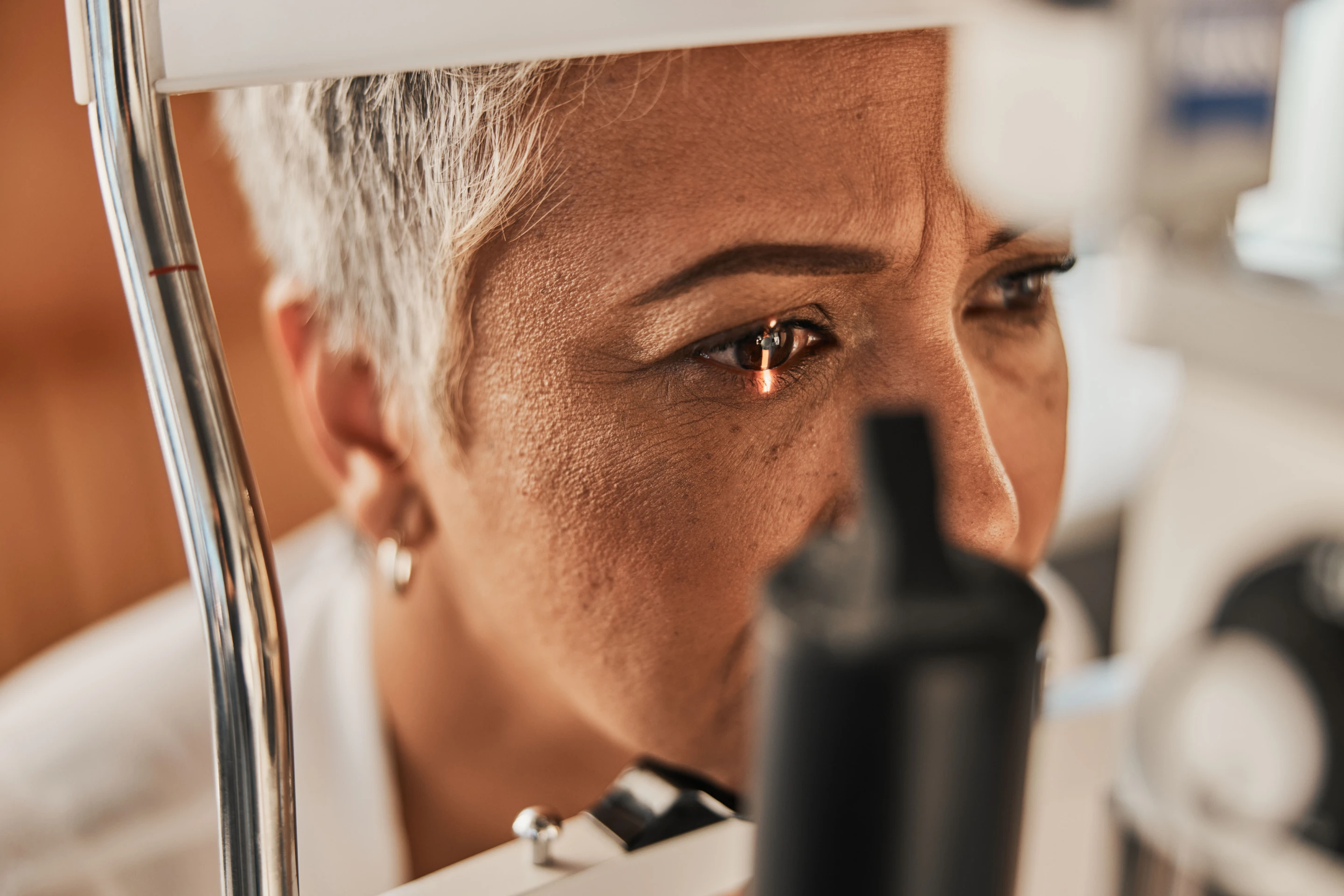
One of the most important steps adults can take to protect vision is having regular dilated eye exams where eye care professionals can clearly see the retina and macula. Early signs of AMD and other eye diseases can be detected. This matters because vision changes may not appear until damage has already occurred. Many experts recommend adults 60 and older have a dilated eye exam every year, or as advised by their eye care professional.2,5
Risk Factors for AMD / Everyday Steps That May Help Protect Vision
Risk Factors for AMD
Some risk factors cannot be changed, but others can be addressed.2,6 Risk factors include:
- Increasing age (especially over 55)
- Family history of AMD
- Smoking (current or past)
- High blood pressure, heart disease, or high cholesterol levels
- Diet high in saturated fat
- Long-term sun exposure without eye protection
Understanding your risk can help guide preventive steps.
Everyday Steps That May Help Protect Vision
While AMD cannot always be prevented, these habits support eye health and overall well-being:2,7,8
1. Get Regular Eye Exams
Routine, dilated exams help detect changes early and track progression.
2. Don’t Smoke
Smoking is one of the strongest modifiable risk factors for AMD. Quitting can help slow further damage.
3. Eat a Nutrient-Rich Diet
A healthy eating pattern may support the retina:
- Leafy greens (spinach, kale, collards)
- Colorful fruits and vegetables
- Fatty fish like salmon, mackerel, anchovies, sardines, or herring (SMASH)
- Nuts, seeds, and whole grains
4. Protect Your Eyes from the Sun
Wear sunglasses that block 100% of UVA and UVB rays and a wide-brimmed hat outdoors to help reduce cumulative sun (UV) exposure and support long-term eye health.9
A NOTE ABOUT DYE-FREE PRODUCTS: Dye-free medications and supplements are a great option for individuals who prefer or require products without dyes, such as those with allergies, sensitivities, or personal preferences. Importantly, both dye-containing and dye-free options are held to the same rigorous safety and quality standards. If you’re unsure which is right for you or your family, talk to your pharmacist or healthcare provider. They can help you choose the option that best suits your needs.
Understanding AREDS Formulas
The Age-Related Eye Disease Studies (AREDS/AREDS2) were major clinical trials sponsored by the National Eye Institute.10 The AREDS studies were designed to learn more about the natural history and risk factors of age-related macular degeneration (AMD) and cataracts, and to evaluate the effect of vitamins on the progression of these eye diseases.
What the research shows:
- Supplements containing the nutrient formulations studied by the National Eye Institute do not prevent AMD from developing.
- They are not recommended for people who do not have AMD.
- They may help slow the risk of progression in people with diagnosed intermediate to advanced AMD.*
The nutrients in AREDS formulas are:
- Vitamin C
- Vitamin E
- Zinc
- Copper
- Lutein
- Zeaxanthin
Talk to Your Doctor First About Supplements
Supplements are not for everyone. High doses of certain nutrients can interact with medications or other health conditions. Always talk with your doctor or eye care professional before starting them.
What About Caregivers?
If you're supporting a family member with AMD, you play an important role. At home, smallchanges can preserve independence and safety: improved task lighting, large-print materials,contrast-colored labels, and magnifying tools. Many people with AMD continue to live full, activelives with the right support in place. Ask their eye care provider about low vision resources andspecialty care.
The Bottom Line
Age-related macular degeneration is common as we get older, but it doesn’t affect everyone the same way. While there is no cure, early detection, regular dilated eye exams, healthy lifestyle choices, and informed conversations with eye care professionals can make a meaningful difference.
For some people with specific stages of AMD, AREDS-formula supplements may help slow the risk of progression, but they are not a cure and are not meant for everyone, so be sure to talk to your doctor.*
Staying informed and proactive is one of the best ways to support long-term eye health as you age.
References:
- http://www.washingtonpost.com/wp-dyn/content/article/2005/09/30/AR2005093001998.html
- http://www.mayoclinic.com/health/drug-information/DR602285/DSECTION=precautions-
- http://www.drugs.com/drug-interactions/multivitamin.html
- http://www.naturemade.com/resource-center/articles-and-videos/immune-health/timing-your-vitamins
- http://www.nlm.nih.gov/medlineplus/druginfo/natural/912.html
- http://ods.od.nih.gov/factsheets/VitaminA-HealthProfessional/
- http://www.prevention.com/food/healthy-eating-tips/your-breakfast-giving-you-cancer
- http://ods.od.nih.gov/factsheets/Iron-HealthProfessional/
- http://www.ag.ndsu.edu/pubs/yf/foods/fn1607.pdf
- http://www.fda.gov/Food/DietarySupplements/UsingDietarySupplements/ucm110567.htm
Safe Use Tips & Takeaways
Heart Health Takeaways
What is fluoride?

Fluoride is a natural mineral found in water, soil, and some foods. It strengthens your enamel, repairs early signs of damage, and makes teeth more resistant to acids from bacteria and sugar.
Is fluoride toothpaste still the most effective option, or are fluoride-free formulas just as good?
Fluoride is still the gold standard for cavity protection. Fluoride-free options can clean your teeth, but they don’t offer the same enamel-strengthening power.
Is fluoride safe for daily use?
Yes. When used as directed, fluoride is safe and effective. It’s been trusted and recommended by major health organizations for over 70 years.
How does fluoride actually protect teeth?
It strengthens enamel, repairs early signs of decay through remineralization, and makes teeth more resistant to acids from bacteria and sugary foods.
Are there any risks to using fluoride long-term?
The main risk—especially for young kids—is swallowing too much, which can lead to mild fluorosis (faint white streaks on teeth). Using the right amount prevents this. For parents, supervise brushing to ensure kids spit out the toothpaste and don't swallow it.
At what age should kids start using fluoride toothpaste?
As soon as the first tooth appears!
* Under 3 years: a tiny rice-sized smear
* Ages 3–6+: a pea-sized amount
Supervise brushing so they don’t swallow it.
* Under 3 years: a tiny rice-sized smear
* Ages 3–6+: a pea-sized amount
Supervise brushing so they don’t swallow it.
Is fluoride still safe and recommended for kids with all the claims online?
Yes. A lot of online claims can be confusing, but decades of research show fluoride is safe and strongly recommended for cavity prevention when used properly.
How much fluoride should my child get from toothpaste?
Use age-appropriate amounts and brush twice a day. If your water isn’t fluoridated, ask your dentist about additional options.
How do I know which kids’ toothpaste claims are real and not just marketing?
Check for the ADA Seal of Acceptance and choose brands your dentist recommends.
Do fluoride-free or “natural” toothpastes protect kids from cavities?
They can help clean teeth, but they don’t provide the same cavity protection as fluoride toothpastes.
Are fluoride-free toothpastes just as effective for adults?
Not for cavity prevention. Fluoride-free toothpastes can help with cleaning and freshening breath, but they do not protect against cavities the way fluoride does. For adults, or anyone who is prone to cavities, fluoride toothpaste remains the most effective option for preventing tooth decay.
Do fluoride alternatives like nano-hydroxyapatite (nHAp) make a difference?
Yes—nHAp can help with sensitivity and early enamel repair. But it hasn’t matched fluoride’s cavity-prevention strength in studies.
How do I compare fluoride vs. fluoride-free options if I have sensitivity or enamel wear?
Fluoride is best for strengthening enamel and cavity prevention. nHAp may help with sensitivity and enamel repair. Some people benefit from using both in a balanced routine. Talk to your dentist about what's right for your specific needs.
Are whitening toothpastes safe to use with fluoride or fluoride-free products?
Most are safe but can be abrasive. Choose gentle formulas and avoid using them every single day—especially for kids.
What should I look for when choosing an OTC toothpaste?
Pick products with proven active ingredients (like fluoride), check for the ADA Seal of Acceptance, and avoid unnecessary additives or sweeteners.
Does fluoride affect hormones or the brain?
No credible scientific evidence shows fluoride at levels used in toothpaste or properly fluoridated water (0.7 mg/L) disrupts hormones or causes neurodevelopmental harm.
What should I do if my community stops adding fluoride to the water?
Use fluoridated toothpaste, consider fluoride rinses (for ages 6+), and talk to a dentist about fluoride supplements for kids (if needed).
Do fluoride supplements have side effects?
They’re safe when used under dental guidance and typically recommended for children in areas without fluoridated water or at high risk for cavities.
What’s the best way to make sure I’m getting enough fluoride?
Brush twice daily with fluoride toothpaste, drink fluoridated tap water if available, and ask your dentist for personalized advice if you’re cavity-prone.
Frequently Asked Questions about AMD
Dig Deeper. Learn More.
Here are some other articles you might find helpful.