.svg)

Acetaminophen Safety for the Whole Family
Acetaminophen Safety for the Whole Family

Acetaminophen Safety for the Whole Family
Acetaminophen Safety for the Whole Family
Funding for content provided by Bayer®
Funding for content provided by Bausch + Lomb


In this article:
Thank you! Your submission has been received!
Oops! Something went wrong while submitting the form.
Jump to a section:
Thank you! Your submission has been received!
Oops! Something went wrong while submitting the form.
What is acetaminophen and how does it work?
Acetaminophen is an active ingredient found in a wide range of single-ingredient and combination over-the-counter (OTC) and prescription (Rx) medicines used to treat pain and reduce fever. First marketed in the United States in 1953, acetaminophen is recognized as the most commonly used medications in the US.
Acetaminophen works primarily in the central nervous system by reducing the production of chemicals that raise body temperature and cause pain and inflammation (prostaglandins) and by blocking pain perception signals.
Other OTC medicines for pain and fever relief contain active ingredients that belong to a class of medications known as “non-steroidal anti-inflammatory drugs” or NSAIDs. These include medicines such as ibuprofen, aspirin, and naproxen. These medicines work in a similar manner, decreasing the production of prostaglandins which contribute to inflammation, pain and fever.
I encourage my patients to read all the Drug Facts labels on their OTC medicines and the information that comes with their prescription medicines before they take them. Over 600 medicines including prescription and OTC products contain acetaminophen in the active ingredient list.
Although acetaminophen is well tolerated by most people, those who have liver damage or end-stage kidney disease should ask their doctors if it is safe for them to use it. Acetaminophen may interact with certain seizure medications so those with seizure disorders should also check with their doctor before using acetaminophen. In rare cases, people may be allergic to acetaminophen and should not take it if a severe rash develops.
Important Update: Acetaminophen
There’s been a lot of talk recently about misleading claims that taking acetaminophen during pregnancy can cause autism. We’ve pulled together some FAQs and answers to help families.
Learn more and get the facts about acetaminophenHow can I ensure my family uses acetaminophen safely?
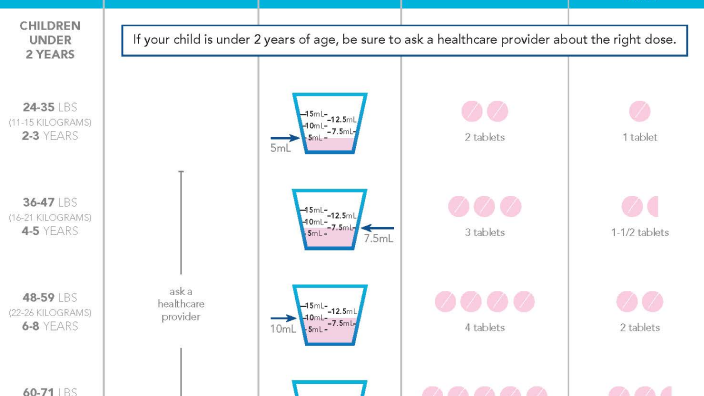
The most important aspect of using and administering acetaminophen safely is to read and understand the directions on the Drug Facts label and to follow the recommended dosing of acetaminophen. Use the approved dose cups/syringes to insure proper dosing for babies and children. Never “guestimate” your doses.
Single-ingredient liquid infants’ and children’s acetaminophen products are only available in one strength (160mg/5mL) to make it easier for parents and caregivers to use these medicines and to reduce potential medication errors. The medicines have age-appropriate dosing directions and devices with each package.
- For infants younger than two years of age, parents and caregivers must consult their healthcare provider for dosing instructions as noted on the Drug Facts label for infant acetaminophen products.
- For children between the ages of 2 through 11, dosing is age or weight-based. Generally, the recommendations are: 10-15 mg/kg/dose every four to six hours as needed, not to exceed five doses (2.6 g) in 24 hours.
- For children 12 and older and adults, “regular release” oral formulations recommend 325-650 mg every four to six hours or 1000 mg three to four times daily (maximum: 4 g daily). While “extended release” oral formulations should be limited to 1300 mg every eight hours (maximum: 3.9 g daily).
- For seniors (adults over age 65), the official FDA recommendation is the same as for adult dosing, with a maximum safe limit of 4g of acetaminophen per day. However, some physicians feel that since older adults may be slower to break down the drug in their livers, a 3 g per day limit is prudent. In my opinion, it is always best to take the smallest effective dose. So if a lower dose of acetaminophen manages your pain or fever symptoms adequately, there is no need to take more of it.
The body breaks down acetaminophen differently than other pain relievers. The liver is primarily responsible for removing the drug from the body, but in cases of overdose, the liver can become injured. Although acetaminophen is well tolerated by most people at safe doses (and has few drug interactions), overdoses can be very dangerous, and in extreme cases can result in liver failure or death.
A NOTE ABOUT DYE-FREE PRODUCTS: Dye-free medications and supplements are a great option for individuals who prefer or require products without dyes, such as those with allergies, sensitivities, or personal preferences. Importantly, both dye-containing and dye-free options are held to the same rigorous safety and quality standards. If you’re unsure which is right for you or your family, talk to your pharmacist or healthcare provider. They can help you choose the option that best suits your needs.
How do I safely store acetaminophen at home?
Safety is essential. Here are my top tips for safe acetaminophen storage:
- Keep acetaminophen in its original bottles. The medicine can be affected by moisture and extremes in temperature. Product quality can only be assured if it is stored in its original containers as directed.
- Check the expiration dates. Safely dispose of all expired acetaminophen to ensure a safe and effective product. Check the Drug Facts label on your medicine packaging. Acetaminophen may be one of several active ingredients in multiple different products. Avoid accidental overdose.
- Keep acetaminophen up and away and out of the sight and reach of children, stored in a locked drawer or in a high cabinet that they cannot access. Do not leave acetaminophen in your purse or coat pockets. Learn more tips on how to childproof your home and medicine cabinet.
References:
- http://www.washingtonpost.com/wp-dyn/content/article/2005/09/30/AR2005093001998.html
- http://www.mayoclinic.com/health/drug-information/DR602285/DSECTION=precautions-
- http://www.drugs.com/drug-interactions/multivitamin.html
- http://www.naturemade.com/resource-center/articles-and-videos/immune-health/timing-your-vitamins
- http://www.nlm.nih.gov/medlineplus/druginfo/natural/912.html
- http://ods.od.nih.gov/factsheets/VitaminA-HealthProfessional/
- http://www.prevention.com/food/healthy-eating-tips/your-breakfast-giving-you-cancer
- http://ods.od.nih.gov/factsheets/Iron-HealthProfessional/
- http://www.ag.ndsu.edu/pubs/yf/foods/fn1607.pdf
- http://www.fda.gov/Food/DietarySupplements/UsingDietarySupplements/ucm110567.htm
Safe Use Tips & Takeaways
Heart Health Takeaways
I encourage my patients to read all Drug Facts labels on their OTC medicines and the information that comes with their prescription medicines before they take them. Over 600 medicines—including prescription and OTC products—contain acetaminophen in the active ingredient list.
Also, some people find that either acetaminophen or NSAIDs work better for their pain. I recommend to my patients that they try them both separately as directed on the Drug Facts label and compare the results.
What is fluoride?

Fluoride is a natural mineral found in water, soil, and some foods. It strengthens your enamel, repairs early signs of damage, and makes teeth more resistant to acids from bacteria and sugar.
Is fluoride toothpaste still the most effective option, or are fluoride-free formulas just as good?
Fluoride is still the gold standard for cavity protection. Fluoride-free options can clean your teeth, but they don’t offer the same enamel-strengthening power.
Is fluoride safe for daily use?
Yes. When used as directed, fluoride is safe and effective. It’s been trusted and recommended by major health organizations for over 70 years.
How does fluoride actually protect teeth?
It strengthens enamel, repairs early signs of decay through remineralization, and makes teeth more resistant to acids from bacteria and sugary foods.
Are there any risks to using fluoride long-term?
The main risk—especially for young kids—is swallowing too much, which can lead to mild fluorosis (faint white streaks on teeth). Using the right amount prevents this. For parents, supervise brushing to ensure kids spit out the toothpaste and don't swallow it.
At what age should kids start using fluoride toothpaste?
As soon as the first tooth appears!
* Under 3 years: a tiny rice-sized smear
* Ages 3–6+: a pea-sized amount
Supervise brushing so they don’t swallow it.
* Under 3 years: a tiny rice-sized smear
* Ages 3–6+: a pea-sized amount
Supervise brushing so they don’t swallow it.
Is fluoride still safe and recommended for kids with all the claims online?
Yes. A lot of online claims can be confusing, but decades of research show fluoride is safe and strongly recommended for cavity prevention when used properly.
How much fluoride should my child get from toothpaste?
Use age-appropriate amounts and brush twice a day. If your water isn’t fluoridated, ask your dentist about additional options.
How do I know which kids’ toothpaste claims are real and not just marketing?
Check for the ADA Seal of Acceptance and choose brands your dentist recommends.
Do fluoride-free or “natural” toothpastes protect kids from cavities?
They can help clean teeth, but they don’t provide the same cavity protection as fluoride toothpastes.
Are fluoride-free toothpastes just as effective for adults?
Not for cavity prevention. Fluoride-free toothpastes can help with cleaning and freshening breath, but they do not protect against cavities the way fluoride does. For adults, or anyone who is prone to cavities, fluoride toothpaste remains the most effective option for preventing tooth decay.
Do fluoride alternatives like nano-hydroxyapatite (nHAp) make a difference?
Yes—nHAp can help with sensitivity and early enamel repair. But it hasn’t matched fluoride’s cavity-prevention strength in studies.
How do I compare fluoride vs. fluoride-free options if I have sensitivity or enamel wear?
Fluoride is best for strengthening enamel and cavity prevention. nHAp may help with sensitivity and enamel repair. Some people benefit from using both in a balanced routine. Talk to your dentist about what's right for your specific needs.
Are whitening toothpastes safe to use with fluoride or fluoride-free products?
Most are safe but can be abrasive. Choose gentle formulas and avoid using them every single day—especially for kids.
What should I look for when choosing an OTC toothpaste?
Pick products with proven active ingredients (like fluoride), check for the ADA Seal of Acceptance, and avoid unnecessary additives or sweeteners.
Does fluoride affect hormones or the brain?
No credible scientific evidence shows fluoride at levels used in toothpaste or properly fluoridated water (0.7 mg/L) disrupts hormones or causes neurodevelopmental harm.
What should I do if my community stops adding fluoride to the water?
Use fluoridated toothpaste, consider fluoride rinses (for ages 6+), and talk to a dentist about fluoride supplements for kids (if needed).
Do fluoride supplements have side effects?
They’re safe when used under dental guidance and typically recommended for children in areas without fluoridated water or at high risk for cavities.
What’s the best way to make sure I’m getting enough fluoride?
Brush twice daily with fluoride toothpaste, drink fluoridated tap water if available, and ask your dentist for personalized advice if you’re cavity-prone.
Dig Deeper. Learn More.
Here are some other articles you might find helpful.